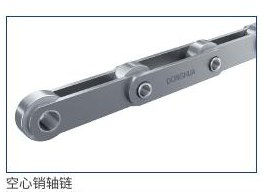
Designing Cross-Rods and Attachments Through Hollow Pins
The hollow pin creates a convenient mechanical interface, but the rod or attachment inserted through it becomes a loaded machine component. Bending, fretting, clearance, retention and interference with sprockets or guides must be checked before the conveyor goes into service.
1. Start with machine geometry, not a model number
Record shaft centers, available sprocket diameter, required conveying pitch, rail position, chain width, side clearances and the space available for the attachment. If an existing chain is being replaced, measure several unworn components and photograph the sprocket and chain path. A model code is helpful, but geometry is the more reliable cross-reference when old equipment has been modified.
For catalogue families with several pitch options, lock the exact pitch before sprocket design. The same family designation can cover multiple pitches while keeping other component proportions within that family. This is why a quotation request should include both the family or model and the selected pitch.
2. Define the hollow-pin job
The inside diameter of the hollow pin determines what can pass through the chain, but that does not mean the inserted rod should simply match the hole. Assembly clearance, coatings, contamination and thermal expansion can all influence fit. Decide whether the rod is fixed to both chains, rotates, floats axially or carries a bolted fixture. Define how it is retained and how it can be replaced during maintenance.
If two parallel chains are connected by cross-rods, the rods can also transmit alignment errors between the strands. Sprocket timing, guide parallelism and the stiffness of the rods therefore become part of the chain-system design.
3. Choose roller arrangement and guidance
Some hollow pin conveyor-chain families are shown in rollerless, small-roller, large-roller and flanged-roller versions. Large rollers can reduce sliding on suitable rails, while flanged rollers can add lateral guidance. Rollerless or bush-running arrangements may suit compact or specially guided mechanisms. The rail material, speed, lubrication and contamination should be selected as a system.
4. Separate breaking load from working load
Catalogue tensile or breaking values are useful for comparing sizes and confirming product identity, but they are not a direct allowable working load. Real conveyor sizing must account for chain pull, acceleration, shock, starts per hour, vertical lift, friction, temperature, wear allowance and an appropriate engineering safety factor. For critical equipment, the machine designer should calculate the actual duty rather than selecting by a single tensile number.
5. Match the environment
Carbon-steel and stainless chain configurations behave differently in wet, abrasive, hot or chemically aggressive service. For washdown machinery, list the cleaning agent, concentration, temperature and rinse procedure. For dry food, powder or packaging lines, consider whether conventional lubrication is acceptable or whether contamination control changes the lubrication strategy. For outdoor or humid service, corrosion protection and storage conditions matter before the chain is even installed.
6. Confirm sprockets, tension and installation
Sprockets must match pitch and roller or bush geometry. Alignment errors force the chain against tooth flanks and guides, increasing wear. Install with the chain tension recommended for the conveyor architecture rather than pulling the chain tight. Conveyor chains need controlled slack so articulation can occur without excessive bearing pressure.
After commissioning, inspect the system under real load. Look for tight spots, uneven strand tension, roller skidding, guide rubbing, attachment contact and unusual noise. Recheck after the first production period because new components can bed in and fixtures may settle.
7. Build a maintenance record
Track chain elongation, roller or bush wear, plate damage, corrosion, stiff joints and attachment condition. When rods pass through hollow pins, include the rod-to-pin interface in the inspection. A maintenance record makes replacement decisions more objective and helps identify whether a change in product, cleaning cycle or conveyor speed is increasing wear.
RFQ checklist
- Model/family and exact pitch
- Hollow pin bore requirement
- Roller configuration
- Chain width and number of strands
- Attachment or cross-rod drawing
- Sprocket tooth count and center distance
- Speed, load, shock and starts per hour
- Temperature, corrosion and washdown exposure
- Quantity and destination
Use this checklist to compare catalogue candidates and then request an engineering confirmation before ordering. The goal is a chain-and-attachment system that fits the machine, carries the real duty and remains practical to maintain.
7. Check rod bending and torsion
A cross-rod is not only a connector. Product weight, fixtures and acceleration can bend it, while skewed loading can twist it. Calculate or test deflection at the longest unsupported span. Excessive flex can alter product position and can also lever against the hollow-pin bore.
8. Choose retention for the service task
Common approaches include clips, cotters, threaded ends, collars and custom retainers. The right choice depends on vibration, cleaning, operator access and whether the rod must rotate. Whatever method is used, ensure the retainer cannot interfere with side plates, guides or guards during articulation.
9. Standardize attachment stations
On a conveyor with many fixtures, use a controlled spacing scheme and document which chain pitches carry attachments. This makes replacement easier and reduces the risk of installing a fixture one pitch out of position. If two strands are linked, mark corresponding attachment stations on both chains.
Frequently asked questions
What information should I send with an RFQ?
Include model if known, measured dimensions, sprocket details, attachment drawing, speed, load, environment and quantity.
Are catalogue tensile values working loads?
No. They are identification/comparison values. Allowable duty requires application engineering and current product confirmation.
Can an old chain be cross-referenced from a photo only?
A photo helps, but measurements and sprocket information are needed for a reliable dimensional cross-reference.