Description
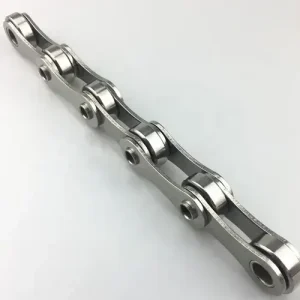
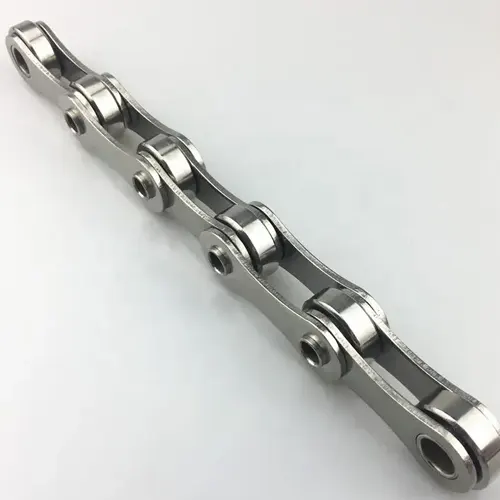
Stainless Steel Hollow Pin Chain 60HPSS
60HPSS is presented for medium-pitch stainless conveyors where cross-rods, flight bars or custom fixtures pass through the chain. The selection should be completed from the documented dimensions below plus the actual load, speed, environment, attachment geometry and sprocket data.
Selection Summary
Use this model when the pitch and hollow-pin envelope fit the conveyor architecture, then verify the cross-rod or attachment diameter, side clearance, sprocket geometry and expected duty cycle. The dominant engineering risk for this model is that two-strand conveyors should specify matched lengths and cross-rod stiffness to avoid load skew.
Key Parameters
| Pitch P | 19.05 mm |
|---|---|
| Roller d1 | 11.91 mm |
| Width b1 | 12.70 mm |
| Pin d2 | 8.31 mm |
| Hollow d3 min | 6.00 mm |
| Breaking load Q min | 16.8 kN |
| Weight q | 1.31 kg/m |
Hollow Pin Function
The hollow pin creates a mechanical passage through the chain joint so rods, bolts or purpose-designed fixtures can be installed across one or two strands. This can simplify carrier changes, but the attachment becomes part of the load path. Specify rod diameter, unsupported span, end retention and any repeated bending or impact.
Application Fit
Typical engineering uses include packaging machines, food-processing conveyors, automated handling, light assembly transfer and logistics equipment. Suitability depends on actual load, environment and guarding; application labels alone are not a substitute for a duty calculation.
Integration Checks
- Confirm pitch, roller diameter, inner width and sprocket tooth form.
- Confirm hollow diameter against the attachment or cross-rod tolerance.
- For two-strand conveyors, specify centre distance, matched chain length and cross-rod stiffness.
- State washdown chemistry, temperature, abrasive contamination or dry-running expectations.
- Provide conveyor speed, shock factor, start-stop frequency and total moving mass.
Maintenance Plan
Inspect elongation, joint freedom, roller condition, attachment retention and sprocket wear as a system. Establish lubrication or dry-running practices that are compatible with the process. Replace damaged rods or distorted attachments before they transfer uneven loads into the chain.
RFQ Checklist
Send the model, quantity or required length, sprocket information, attachment drawing, cross-rod diameter and span, conveyor speed, transported mass, operating temperature, cleaning or chemical exposure, and photos or CAD where available.
Can the hollow pin accept any rod diameter?
No. Use the documented minimum hollow diameter as a starting point, then allow manufacturing clearance, retention hardware and movement.
Can I replace a standard chain only by matching pitch?
No. Verify roller, width, pin and sprocket geometry as well as pitch.
What changes for paired chains?
Matched length, shaft parallelism, cross-rod stiffness and fixture squareness become especially important.
Customer Reviews & Case Studies
Representative application-fit scenarios by market, organized for engineering review.
Food & Packaging Machinery
Use Case: Washdown-adjacent tray transfer with removable cross-rods
Engineering Review: Selection focus: quick fixture change, cleanable geometry and verified chemical compatibility.
Automation Equipment
Use Case: Compact indexing conveyor with paired chain strands
Engineering Review: Selection focus: matched lengths, controlled alignment and low assembly variation.
Packaging & Process Equipment
Use Case: Product-carrier conveyor for frequent format changes
Engineering Review: Selection focus: cross-rod access and serviceability without dismantling the chain.
Technical Reference
Model dimensions in this page are tied to the Ever-Power source register entry for 60HPSS. Final production drawings and application suitability should be confirmed in the RFQ.