FVC Series
FVC Series FVC140 – Hollow Pin Chain
A robust FVC-series hollow pin conveyor chain for long-pitch conveyor layouts and attachment-driven material handling.
Product Overview
A robust FVC-series hollow pin conveyor chain for long-pitch conveyor layouts and attachment-driven material handling.
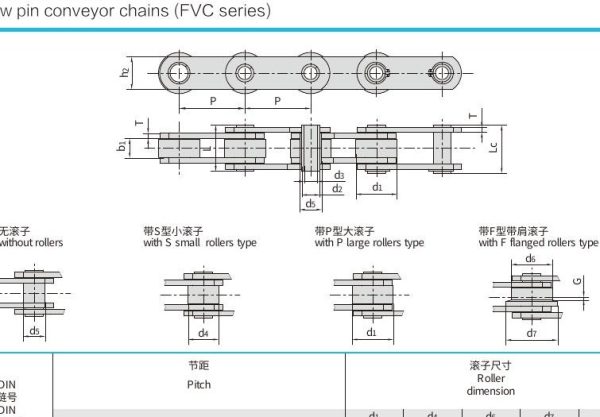
FVC-series hollow pin conveyor chains use a larger conveyor-chain envelope intended for attachment-driven material handling. The hollow pin provides a practical interface for cross-rods and fixtures, while the chain dimensions determine the sprocket and guide geometry. FVC model identity should therefore be confirmed by measurements and operating conditions rather than by model code alone.
For a replacement project, compare the existing chain with the catalogue dimensions and with the machine itself. Measure pitch across several joints, roller or bush diameter, width between inner plates, plate depth, pin diameter, hollow-pin inside diameter and overall pin length. Photograph the sprocket tooth form, chain guides and the way rods or attachments are retained. These checks reduce the risk of choosing a chain that has a familiar model code but a different pitch or attachment arrangement.
Technical Specifications
| Pitch options (mm) | 100 / 125 / 160 / 200 / 250 |
|---|---|
| Roller dimension d1 max (mm) | 60.0 |
| Width between inner plates b1 min (mm) | 35.0 |
| Pin diameter d2 max (mm) | 18.0 |
| Hollow pin ID d3 min (mm) | 12.0 |
| Pin length L / Lc max (mm) | 67.0 / 68.5 |
| Plate depth h2 max (mm) | 45.0 |
| Plate thickness T max (mm) | 6.0 |
| Ultimate tensile strength Q min | 110.0 kN |
The values above are catalogue identification data for FVC140. Tensile or breaking values are not an allowable working load. Current material, heat treatment, stainless grade, tolerances and production configuration are confirmed during quotation.
How FVC140 Can Be Integrated
The hollow pin is useful when the conveyor needs a repeating mechanical interface. Cross-rods can connect two parallel chains; carrier plates can be mounted to rods; product supports can be positioned at selected pitches; and maintenance fixtures can be designed so that the mounted hardware can be removed without dismantling the complete chain. The attachment design must leave adequate articulation clearance and must not clamp the link plates or interfere with the roller, bush or sprocket engagement.
When two chain strands are linked by rods, strand timing becomes important. A stiff rod can transfer misalignment from one side of the conveyor to the other. Sprockets should be aligned and phased, guides should be parallel, and the rod should have the required assembly clearance through the hollow pins. Retention details such as circlips, nuts, collars or end plates should be selected so that they remain secure but are accessible during service.
Selection and Cross-Reference Checklist
- Model or family, plus the exact selected pitch
- Hollow-pin bore and required rod or bolt diameter
- Roller arrangement: large roller, flanged roller, small roller, bush or rollerless configuration where applicable
- Width between inner plates, plate depth and overall chain envelope
- Sprocket tooth count, tooth form, bore and shaft-center distance
- Conveyor speed, estimated chain pull, acceleration, shock and starts per hour
- Temperature, moisture, washdown chemicals, abrasive contamination and lubrication restrictions
- Attachment drawing, rod spacing, retention method and required quantity
Operating Conditions to Review
Chain selection should separate catalogue tensile identification values from the actual duty calculation. A conveyor can create additional chain pull from friction, acceleration, product accumulation, vertical lift, guides, tensioners and attachments. Shock loading and frequent starts can be especially important. The machine designer should calculate the required working load and apply an appropriate engineering safety factor for the equipment and local rules.
Environment also changes the decision. In wet service, corrosion, lubricant wash-off and trapped contamination around attachments need attention. In dry food or packaging machinery, lubricant migration and cleaning access may matter more than corrosion. In dusty service, abrasive material can enter joints and guides. Stainless construction can improve corrosion resistance, but it does not remove the need to review chemical compatibility, lubrication and wear.
Installation and Maintenance
Before installation, verify sprocket alignment and condition. Worn sprockets can accelerate wear on a new chain. Install the chain with controlled slack appropriate to the conveyor design rather than pulling the strands rigidly tight. Confirm that cross-rods, flights and fixtures do not bind as the chain articulates around the sprockets. After commissioning, inspect the machine under real product load and look for uneven strand tension, guide rubbing, roller skidding, tight joints or attachment contact.
Maintenance records should track elongation, roller or bush wear, corrosion, plate damage, stiff joints and the condition of rods passing through the hollow pins. Measure wear at consistent locations and compare both strands of a twin-chain conveyor. If one strand wears faster, check alignment, load distribution, guide friction and rod geometry before simply replacing the chain.
Engineering FAQ
Can I select FVC140 from the model number alone?
No. Confirm pitch and key dimensions because a family can contain several pitch or roller arrangements, and legacy equipment may have been modified.
Can catalogue tensile strength be used as working load?
No. It is reference data for identification and comparison. Working duty requires a conveyor load calculation that includes shock, acceleration, friction and an engineering safety factor.
What should I send for a cross-reference?
Send model, measured pitch, hollow-pin bore, roller type, chain width, sprocket information, attachment drawing, operating speed, load, environment, quantity and clear photos.
Can the hollow pins accept custom rods or fixtures?
Yes, that is a primary reason to use hollow pin chain, but rod diameter, clearance, retention, bending stiffness and interference through the sprocket path must be engineered for the machine.
RFQ Information
For a quotation, provide the exact model and pitch if known, or a measured chain and sprocket drawing when the model is uncertain. Include the attachment or cross-rod drawing and explain the operating cycle. EVER POWER will use those inputs to confirm the dimensional family and the production configuration available at quotation stage.
APPLICATION FIT
Typical machine contexts to evaluate
Packaging machinery
Cross-rods, carriers and indexed product fixtures.
Food & beverage equipment
Corrosion-aware configurations for wet or hygiene-sensitive machinery.
Conveyor systems
Attachment-ready transfer, accumulation and guided carrier layouts.
Automation & logistics
Repeatable fixture locations for parcel, tote and parts handling.
RELATED PRODUCTS
Compare nearby hollow pin models
FVC Series FVC315 – Hollow Pin Chain
A robust FVC-series hollow pin conveyor chain for long-pitch conveyor layouts and attachment-driven material handling.
FVC Series FVC250 – Hollow Pin Chain
A robust FVC-series hollow pin conveyor chain for long-pitch conveyor layouts and attachment-driven material handling.
FVC Series FVC180 – Hollow Pin Chain
A robust FVC-series hollow pin conveyor chain for long-pitch conveyor layouts and attachment-driven material handling.
REQUEST FOR QUOTATION
Send the chain and attachment details
Include model, pitch, hollow-pin bore, roller type, sprocket details, attachment drawing, speed, load, environment and quantity.